
Stability & Storage
A peptide's shelf life depends almost entirely on how it is stored. This guide covers stability in lyophilized and reconstituted form, and the laboratory handling practices that keep a reference standard usable.
Last updated September 2, 2026
Lyophilized stability
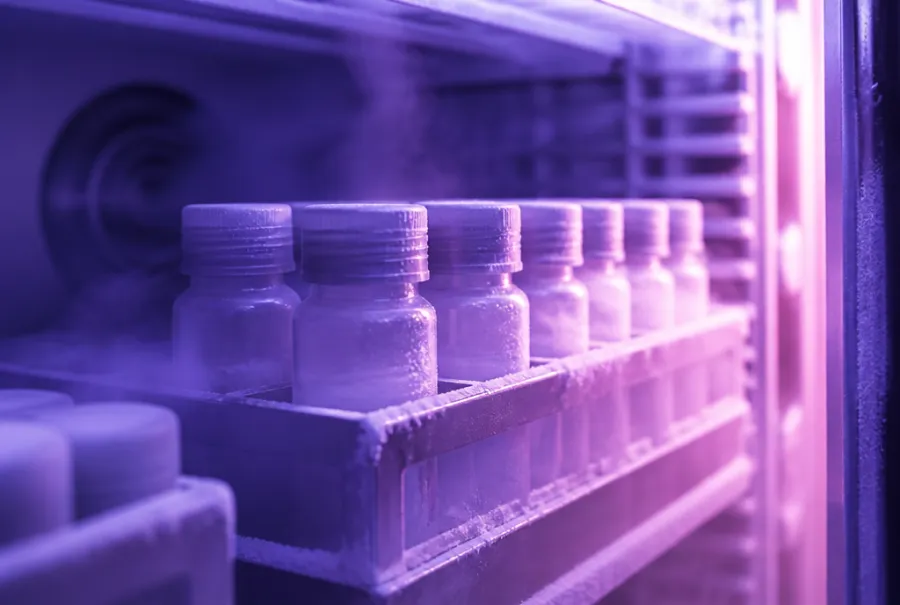
In its freeze-dried state a peptide is at its most stable: the reactions that degrade peptides need water. Sealed lyophilized vials stored at −20°C typically remain within specification for years; for short periods (weeks), refrigeration at 2–8°C is generally acceptable. Keep vials away from light and moisture, and allow a cold vial to reach room temperature before opening it, so ambient humidity does not condense onto the powder.
In solution
Once dissolved, degradation clocks start: hydrolysis, oxidation, and — for some sequences — aggregation. Laboratory solutions should be prepared with an appropriate sterile diluent, kept refrigerated at 2–8°C, and used within days to weeks depending on the sequence. Bacteriostatic water is common for laboratory solution preparation because the preservative suppresses microbial growth in a vial that will be sampled more than once.
Freeze–thaw cycles
Repeated freezing and thawing of a solution damages peptides through ice-crystal shear and local concentration effects. If a solution must be stored frozen, split it into single-use aliquots first so each aliquot is thawed exactly once.
Practical checklist
- Store sealed lyophilized vials at −20°C for the long term; 2–8°C is acceptable for short periods.
- Protect from light and moisture; warm to room temperature before opening.
- Refrigerate solutions at 2–8°C and use within the sequence's documented window.
- Aliquot before freezing solutions; avoid repeated freeze–thaw cycles.
- Label everything with contents, concentration, and preparation date.
RESEARCH USE ONLY — NOT FOR HUMAN CONSUMPTION. Products are laboratory reagents for in-vitro research by qualified professionals. Sale for human use is strictly prohibited. Nothing in this guide is medical advice or dosing guidance.