
Purification & HPLC
Crude synthesis output contains the target peptide alongside deletion and truncation by-products. Reversed-phase HPLC is the standard method for separating them — and the source of the purity percentage on every certificate of analysis.
Last updated September 2, 2026
Reversed-phase HPLC
High-performance liquid chromatography pumps the dissolved crude peptide through a column packed with hydrophobic particles. Each species in the mixture interacts with the column differently depending on its hydrophobicity, so as a solvent gradient runs, different species elute at different times.
The target peptide comes off the column in a defined window; fractions collected in that window are pooled, leaving deletion sequences and other by-products behind in earlier or later fractions.
What a purity percentage means
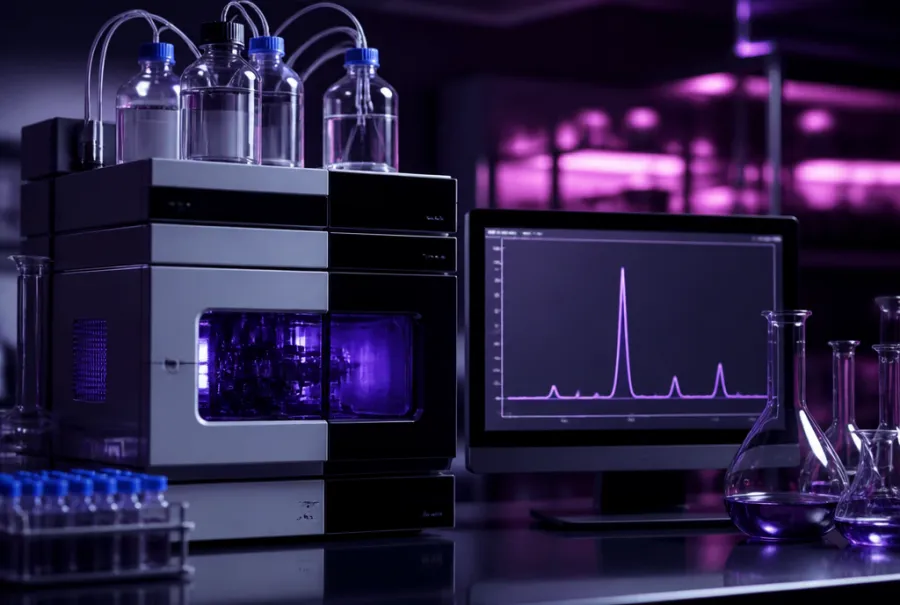
Analytical HPLC of the purified material produces a chromatogram — signal versus elution time. Purity is the area of the main peak as a percentage of the total peak area. A 99% purity figure means 99% of the UV-absorbing material in the sample eluted as the main peak.
Purity is not the same as net peptide content: a lyophilized vial also contains bound water and counter-ions (commonly acetate or TFA salts), which HPLC purity does not measure. Both figures matter when preparing analytical solutions.
After purification
Pooled fractions are lyophilized back to a dry powder, which is what gets weighed into the final vials. Identity of the purified material is then confirmed independently by mass spectrometry — covered in the quality-control guide.
RESEARCH USE ONLY — NOT FOR HUMAN CONSUMPTION. Products are laboratory reagents for in-vitro research by qualified professionals. Sale for human use is strictly prohibited. Nothing in this guide is medical advice or dosing guidance.