
Research Peptide Fundamentals
Peptides are short chains of amino acids joined by peptide bonds. This guide covers what they are at the molecular level, how they differ from proteins, and what separates a research-grade reagent from everything else.
Last updated September 2, 2026
What a peptide is
A peptide is a chain of amino acids — typically between 2 and 50 residues — linked by amide (peptide) bonds formed between the carboxyl group of one amino acid and the amino group of the next. The specific order of residues is the peptide's sequence, and the sequence is what defines the molecule.
Chains longer than roughly 50 residues are conventionally called proteins. The boundary is not a hard chemical line, but it matters in practice: shorter chains rarely fold into stable three-dimensional structures the way proteins do, which changes how they behave in solution and how they are studied.
Why peptides matter in research
Peptides act as signaling molecules in a wide range of biological systems, which makes synthetic versions useful tools for in-vitro work: receptor binding assays, cell-culture signaling studies, analytical method development, and use as reference standards for identifying compounds in complex samples.
Because a peptide is defined entirely by its sequence, a correctly synthesized sample is chemically identical to the sequence it replicates — which is what makes synthetic peptides usable as analytical reference material.
What “research grade” means
Research-grade peptides are manufactured and sold exclusively as laboratory reagents. They are not pharmaceuticals: they are not produced under drug GMP, not evaluated by the FDA, and not intended for human use in any form.
What a research-grade supplier owes the laboratory is identity and purity: the vial contains the stated sequence, at the stated net mass, at a verified purity — documented on a certificate of analysis. See the quality-control guide for how to read one.
The lyophilized format
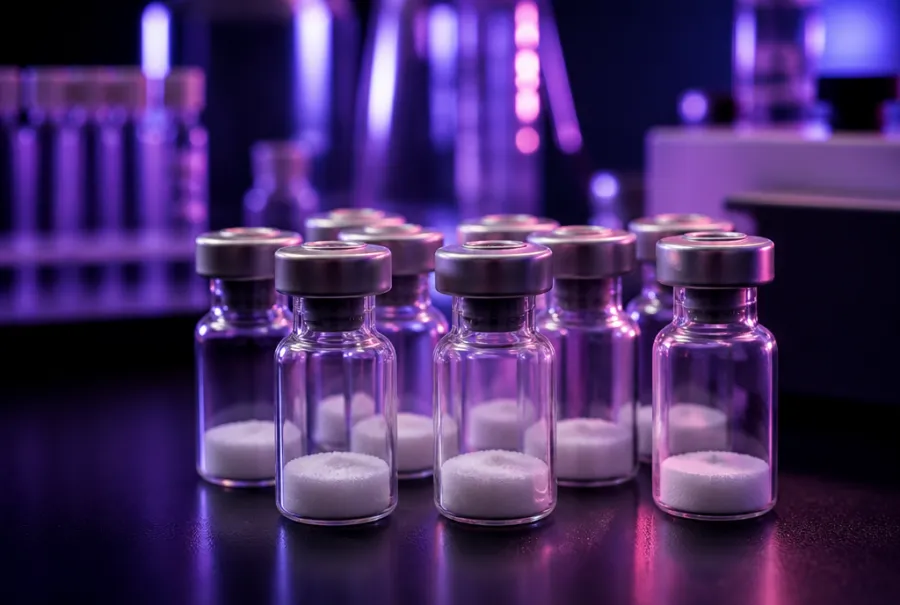
Research peptides ship as a lyophilized (freeze-dried) powder — the white cake at the bottom of the vial. Lyophilization removes water under vacuum at low temperature, leaving the peptide in its most stable form for shipping and storage. The stability & storage guide covers handling from there.
RESEARCH USE ONLY — NOT FOR HUMAN CONSUMPTION. Products are laboratory reagents for in-vitro research by qualified professionals. Sale for human use is strictly prohibited. Nothing in this guide is medical advice or dosing guidance.